
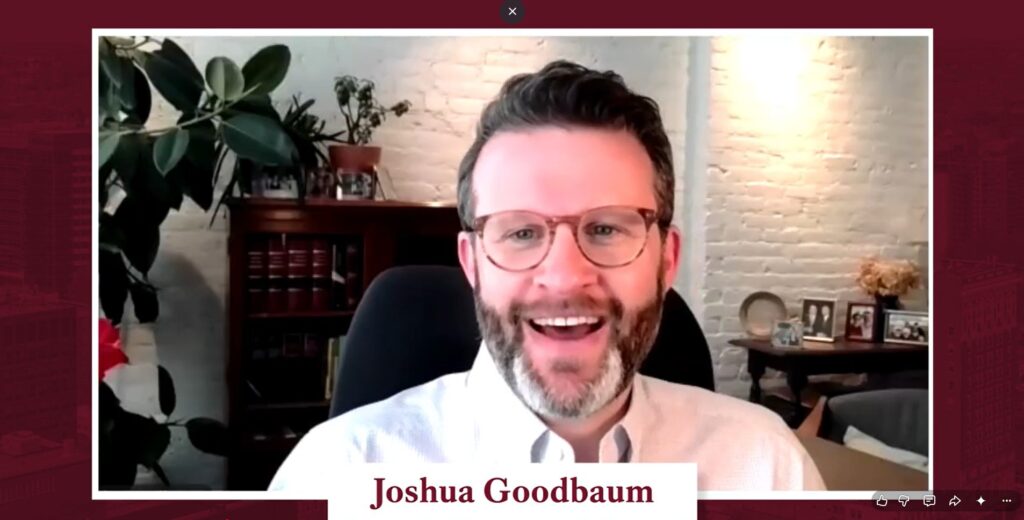

Amanda DeMatteis: Hi, Josh.
Josh Goodbaum: Hi, Amanda. What are we talking about today?
DeMatteis: We’re talking about texting. And we’re talking about whether or not it’s a good idea to text your lawyer – from both sides, both the client and the lawyer. I will confess that I am guilty of texting with my clients. For one reason or another, most of my clients will get my cell phone number through the life of our time working together. Maybe it’s because I’m on vacation or I’m working from home or whatever it may be, and I only have one cell phone. So, the kids’ school is calling, a client is calling, my husband’s calling, you are undoubtedly calling, and it can all get a little bit hairy. So, I thought we would talk about why it is useful not to provide clients with your cell phone number, both from the client’s perspective and the lawyer’s perspective.
Goodbaum: As you know, Amanda, I typically do not give my cell phone number to my clients, and I do that for three reasons.
The first reason is record-keeping. It’s very easy for me to keep track of emails. I know what I’ve read. I know what I haven’t read. I know if it’s in my inbox and needs action. I know if I’ve moved it to a folder. I can translate an email to a to-do item. My emails don’t get lost.
I have an ethical obligation as a lawyer to keep records of my work for my clients, and that becomes harder when I’m dealing with text messages. They get interspersed with all of my personal stuff – my texting with my family and my friends and my coordination of other appointments. So, I want to make sure that I’m keeping careful records, and the best way for me to do that is through email rather than through text messages.
The second reason is privacy. I am the only one who uses my work laptop. I’m the only person who accesses my work email. I’m not the only person who touches my cell phone. For example, I know for you that your kids are often touching your phone. Maybe they accidentally delete a text message, and those can be difficult to retrieve. Once they’re gone, they’re gone. Whereas with emails, we have a backup that runs every day, so we can get them back.
The third reason has less to do with my effectiveness in any particular case, if I’m being honest, and more to do with my effectiveness as an advocate overall. And that reason is my mental health, my work-life balance. I want to work when I want to work. If there’s an emergency, I can be available. I can work nights, I can work weekends, and I often do. But I want to make sure that, on the rare occasions where I’ve decided I’m really not going to work, I do not get a surprise text message from a client that says, “Here’s this non-urgent thing I need.” Those messages take me out of the mode of being a normal person who’s relaxing and recharging, and they put me back into the mode of being an advocate. And being an advocate, as much as I love doing that work, is tiring. So, in an effort to preserve my mental health and to make sure that I have some life that is not consumed by work, I like to prevent my clients from texting me whenever they want.
DeMatteis: That’s really great advice, Josh. I have one more thing to add, both from a client perspective and an advocate perspective. I want to give my clients my best, my most thoughtful response all the time. And I do that when I sit down at my laptop, and I am in lawyer mode. When I’m getting a text message about someone that needs quick advice, I might be in mom mode or wife mode or all the other modes that exist for me, right? And my client may not get my very best. So, I try not to respond to text messages in that setting. It is much less formal.
But it would also be useful from the client’s perspective if they simply email me. They’re going to get a more thoughtful response from whatever lawyer that they’re working with, certainly from me. So, best practices, whether or not you are wearing the lawyer hat or you are wearing the client hat: try to keep communications professional; the best way to do that is through email and not through a text message.
Thank you guys so much for watching. We’ll see you next time. Take care.