
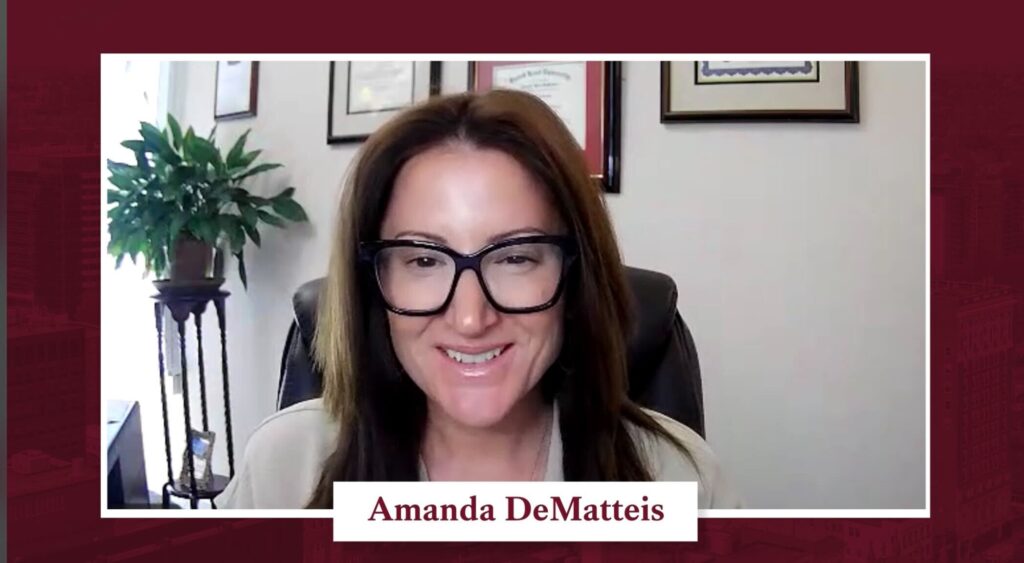

Amanda DeMatteis: Hi, Josh.
Josh Goodbaum: Hi, Amanda. What are we talking about today?
DeMatteis: Well, we’ve been doing some videos where we define legal terms for our viewers, and I have one for you today. It’s certainly a term of art in the legal profession, and that is “constructive discharge.” We have a lot of clients who will reach out and say, “My employment was constructively discharged. You have to help me.” And they may not understand the real definition of that term. Enlighten us.
Goodbaum: This is a tricky one, Amanda, because “constructive discharge” is a complicated term and a lot of non-lawyers, frankly, are misusing it to their detriment.
A constructive discharge exists where an employer engages in discrimination or retaliation that is so egregious and so hostile that a reasonable employee would feel compelled to resign from their job, and then the employee does resign from their job. In that situation, the employee has been effectively terminated, and the employer can be legally liable for the termination.
Note that, in order to be a violation of federal or Connecticut employment law, the constructive discharge typically must be motivated by an impermissible reason – that is, by the employer’s unlawful discrimination or retaliation. If the employer is horrible to everyone, then an unlawful constructive discharge likely does not exist.
Note also that, even though the employer does not have to intend to force the employee to resign, the legal standard for a constructive discharge is very high. It must be that no reasonable employee would feel able or comfortable to continue to work under the conditions created by the employer.
Let me give some examples. Often a constructive discharge takes the form of denying access to the workplace or to an employee’s specific work. So, for example, the employer changes the locks on the building, deactivates employee’s IT login, or turns off the heat in the employee’s office in the winter or air conditioning in the summer. No employee is going to feel comfortable or able to work under those circumstances.
We often see a constructive discharge in the context of the failure to grant or discuss a reasonable accommodation for a disability. This denial often rises to the level of effectively denying the employee the ability to work. Imagine that an employer says, “Well, yes, you can work in your office, but you’re in a wheelchair; there’s no elevator; and your office is on the 2nd floor up a set of stairs.” That’s a constructive discharge.
If the employer is not denying access, then generally the employer’s conduct must be beyond the pale. A court is going to require the employer’s conduct to be very egregious. This might include explicit or implicit threats of violence, such as a noose being hung in the office or cubicle of a person of color. That is the kind of severity we’re talking about here.
A constructive discharge generally does not exist simply because the employer is mean or rude or disrespectful or even because they’re creating a hostile work environment. Most hostile work environments are not constructive discharges. Again, a constructive discharge is a very high bar.
So, before you quit your job thinking that you have a claim for constructive discharge – that you’re going to hire an employment lawyer and they’re going to be able to blame that termination on your employer – talk with an employment lawyer first. Hire a lawyer before you resign. Find an employment lawyer to help guide you through this hostile work environment and support you in understanding whether a constructive discharge really exists in this situation.
DeMatteis: You’d be shocked how many clients come to us having already left their jobs, sometimes relying on AI to tell them that they should. Don’t be one of those people. Reach out to an employment lawyer before you quit your job, so you have all the information relevant to your specific situation before you make any decision about whether to argue that you were constructively discharged.
Thanks so much for watching. We’ll see you next time. Take care.